 Skip to content

Florida’s young people are exposed to gambling influences earlier and more frequently than ever before. From video gaming microtransactions to sports wagering and social pressures, the risks are real and growing. The FCCG provides a comprehensive suite of prevention programs designed to educate, support, and protect youth, teens, and college students. These programs are grounded in research, developmentally appropriate, and built to help young people make informed, healthy decisions. FCCG’s prevention programs are built to intervene early, educate effectively, and empower young people to make healthy choices.
Early Prevention Programs for Elementary Students
FCCG’s prevention efforts begin in elementary school, where children are introduced to the foundations of healthy decision‑making. Younger students learn how peer pressure, dares, and risk‑taking behaviors can mirror gambling and lead to negative consequences. They are encouraged to seek guidance from trusted adults and to understand the importance of honesty and personal responsibility.
Older elementary students explore how spending habits, media influence, and financial choices shape their well‑being. These early lessons help children develop strong critical‑thinking skills and a healthy relationship with money long before they encounter real gambling opportunities.
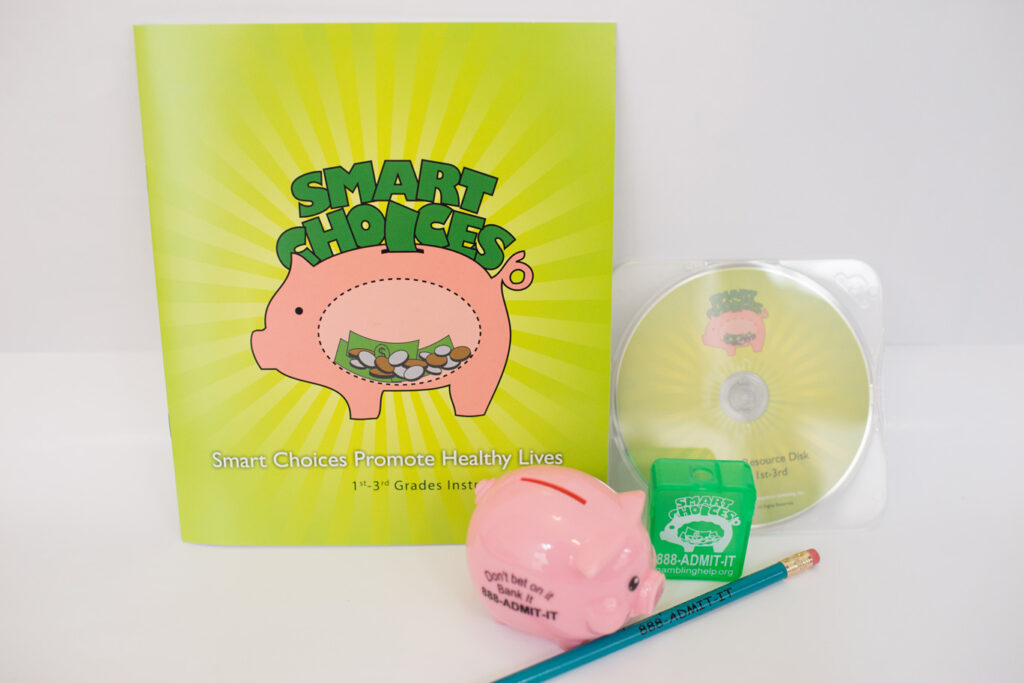
Smart Choices Elementary School Program (1st-3rd Grade)
The lesson plan geared for 1st-3rd graders discusses the role that “dares” play among youth and outlines how these activities are another form of gambling that can present significant risks and problems among this population. It further reinforces the short and long-term consequences of gambling, and helps students to understand they have options and can make smart choices that will be in their best interests, even when pressured by peers to engage in risk-taking activities. Additionally, it promotes honesty as the best policy, the significance of turning to a trusted adult in times of concern, and lays the groundwork that money is not to be wasted but saved for needs and wants.
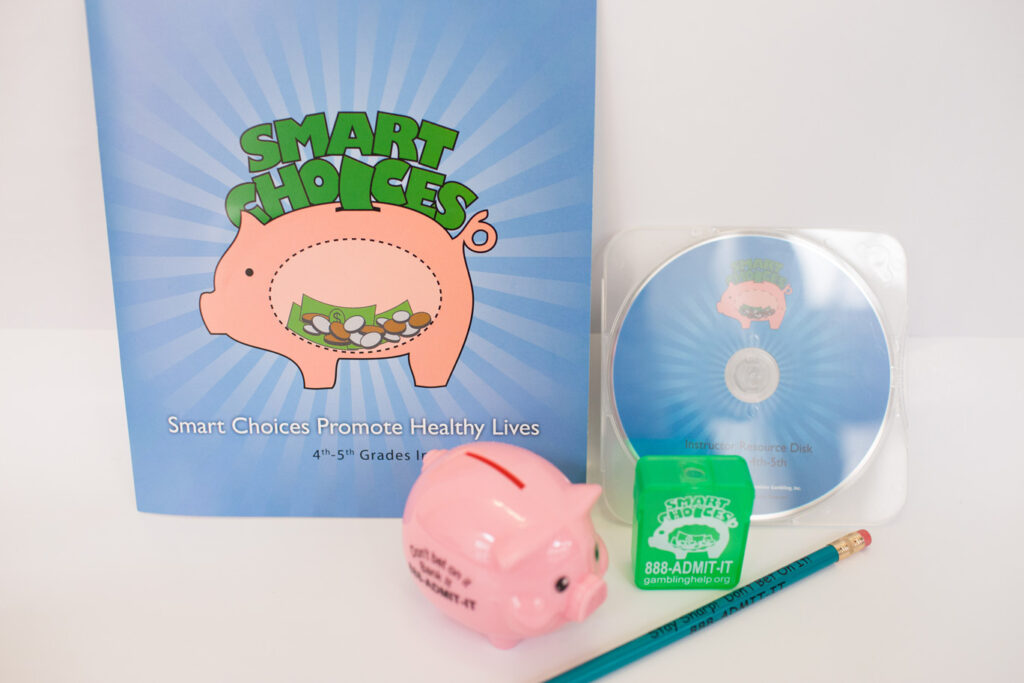
Smart Choices Elementary School Program (4th-5th Grade)
The 4th-5th grade lesson plan highlights the diverse ways in which young people spend money and value different things. It also introduces the concept that one’s financial health impacts upon personal health, enables students to contemplate the ways in which they spend and save money, and helps them to recognize how they prioritize purchases. It further promotes that money should only be spent when persons can afford to do so, demonstrates the influence that the media, peers and other can have on spending habits and purchases, and presents betting with money or other items of value as a risk-taking behavior that has short and long-term impacts.
Middle and High School Gambling Prevention Education
As students enter adolescence, FCCG provides a structured curriculum that integrates seamlessly into existing health and prevention programs. Middle school lessons introduce probability concepts that help students understand chance, randomness, and the realities behind gambling outcomes. High school lessons expand on these ideas by exploring independent and conditional probability, connecting mathematical principles to real‑world gambling risks. This curriculum strengthens students’ analytical skills while highlighting the personal, academic, and social consequences of gambling.
The Problem Gambling Prevention Program for Middle and High School Students is a prevention and behavioral change tool geared toward middle and high school youth, educators, counselors, parents and others associated with problem and compulsive gambling. This prevention program was endorsed by the Florida Departments of Education, Drug Control, Children and Families, Health, Lottery, and Juvenile Justice, and was the first of its kind in the nation.
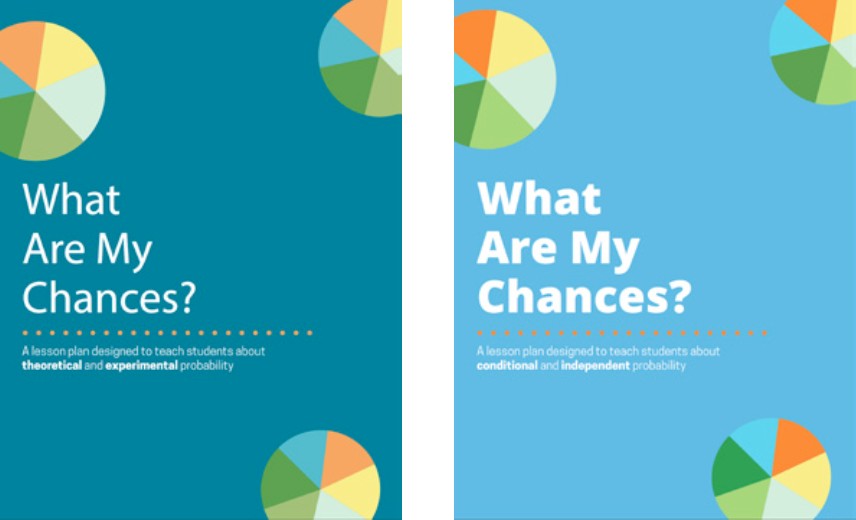
It equips educators, counselors, and parents to deliver essential information about gambling risks and connects naturally to existing alcohol, tobacco, and substance‑use prevention efforts.
The middle school component introduces experimental and theoretical probability to help students understand chance and randomness, while the high school component expands into independent and conditional probability to illustrate real‑world gambling outcomes. Originally aligned with Florida’s Sunshine Standards and later Common Core, the program is slated to be updated to reflect Florida’s latest academic standards and ensure continued relevance in today’s learning environment.
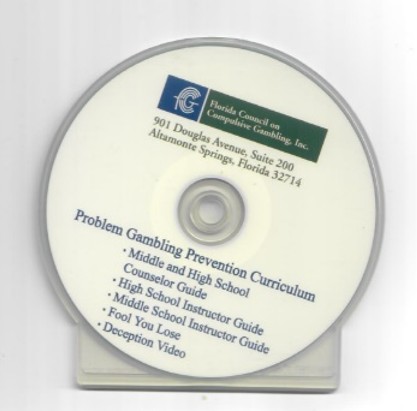
“Problem Gambling Prevention Curriculum” Youth Toolkit PDF for Professionals (Youth Service Providers)
The FCCG’s Youth Toolkit Problem Gambling Prevention Curriculum for Teachers, Administrators, and Guidance Counselors contains the Middle and High School Problem Gambling Curriculum, Counselors and Instructors Guide, and explains how FCCG youth specific problem gambling prevention materials are intended for use. This PDF includes the “Fool You Lose” and Teen “Deception” videos.
Youth Toolkit and Multimedia Prevention Resources
To support educators, counselors, and youth service providers, FCCG offers a comprehensive Youth Toolkit filled with practical, ready‑to‑use prevention materials. The toolkit includes educational guides, interactive activities, and multimedia resources designed to spark meaningful conversations about gambling risks. The teen docudrama video illustrates how gambling behaviors can escalate during adolescence, while an interactive computer game helps students understand the consequences of risky choices. These tools make it easier for adults to engage youth in prevention efforts and intervene early when concerns arise.
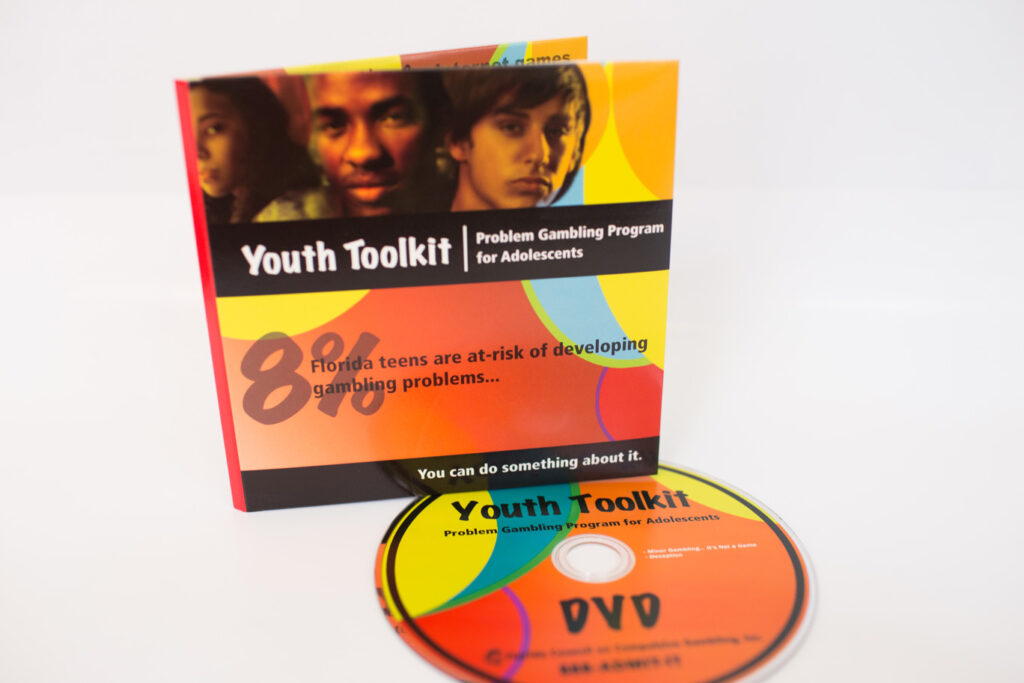
Youth Toolkit
FCCG’s Youth Toolkit, Underage Gambling….It’s Not a Game, furnishes tangible tools for parents, teachers, counselors and students to use to educate adolescents about the dangers of youth gambling. It offers insight, factual information, learning exercises (e.g., the State funded and approved Problem Gambling Prevention Program for Middle and High School Students listed above), a counselor guide, a video docudrama on teen betting, an interactive computer game, Dire Stakes (similar to the popular TV show, Jeopardy, but uses the PowerPoint program), and collateral materials.
Youth/Teen Gambling Awareness Docudrama Video for Youth Gamblers & their Loved Ones (Parents) & Professionals (Youth Service Providers) “Deception”
29-minute docudrama which explores the story of two high school buddies growing up together but taking very different paths in life, as one watches the other develop and progress through the stages of a gambling disorder.
Problem Gambling Prevention Designed for Student Athletes
Sports wagering has become one of the most common forms of gambling among teens, especially those involved in athletics. FCCG addresses this trend through a specialized curriculum developed in partnership with national athletic organizations. This program educates high school athletes about the dangers of sports betting, the impact it can have on academic and athletic eligibility, and the long‑term consequences that gambling can have on their future careers. By reaching athletes early, the program helps prevent gambling behaviors before they become entrenched.
When Gambling Takes Control of the Game
Since we are also aware that for many student athletes, gambling and problem gambling do not begin upon arrival at a College or University, we recognize that awareness and prevention need to begin at a much earlier age. The FCCG teamed up with the National Collegiate Athletic Association and the National Federation of State High School Associations in an effort to curb sports wagering activities in young adults. The three associations, which each have a strong focus on raising awareness and education on the dangers associated with sports wagering, combined efforts to develop and distribute a comprehensive curriculum for high school student-athletes.
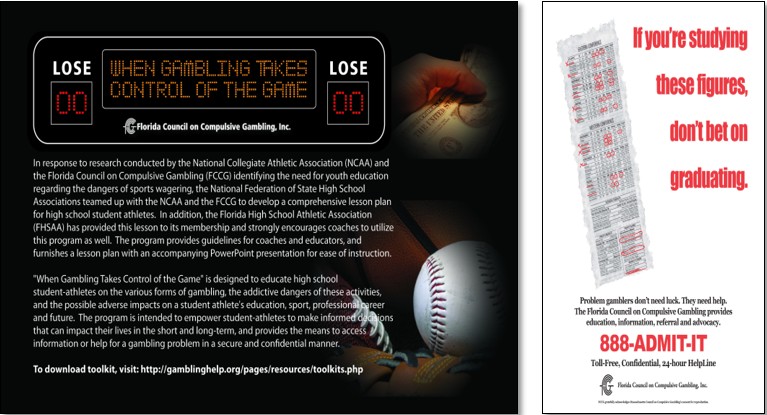
The curriculum is designed to educate high school student-athletes on the various forms of gambling, the addictive dangers of these activities, as well as the possible adverse impacts on a student-athlete’s education, sport, professional career, and future. The three organizations partnered in the development of the curriculum guidelines for coaches and instructors and distributed to high schools nationwide.
Studies conducted by the NCAA and FCCG independently of one another helped identify the opportunity and need for youth education regarding the dangers of sports wagering. An NCAA study of gambling and associated behaviors among collegiate student-athletes found that nearly 45 percent of students surveyed placed their first sports wager in high school or earlier. In addition, FCCG studies confirm that sports wagering is among the top three forms of gambling among Florida adults and is a popular form among adolescents who gamble.
Programs for At‑Risk and High‑Risk Youth: Department of Juvenile Justice Programs
The FCCG sponsored a study within Florida Department of Juvenile Justice (DJJ) facilities, which revealed that 17% of the inmates surveyed attributed their institutionalization in part to gambling, in which 51% were in need of help for a gambling problem. In addition, 10% of the inmates admitted to being detained or arrested due to gambling within the prior 12-month period, 12.5% had been told they need treatment for a gambling problem and 3% had actually received such professional assistance. Essentially, the study speculated that youth may be engaging in income generating crime to pay for a gambling debt or engaged in violence for which they were arrested in order to avoid a gambling debt or some other indirect gambling related offense. Finally, the study concluded that over four-fifths (84% or 356 of 426) of those who gambled in the year prior to institutionalization had at least one negative consequence, which translated to 63% of the entire residential population. Yet, few reported receiving any help for gambling despite problems experienced.
Based on these finding, The FCCG devised and instituted a program, DJJ specific, “Are You Gambling with Your Life?” which provides supports to DJJ counseling personnel, intake and exit staff, and educators. Further, the FCCG designed an accompanying interactive computer game on DVD, which teaches life skills training through realistic video situations and population sensitive music and language. The DVD has been approved for use by DJJ in DJJ facilities.
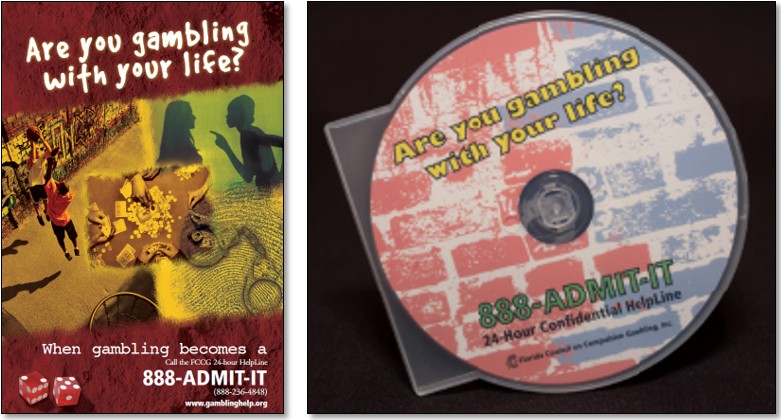
High Risk Youth Program: “Are You Gambling With Your Life?
Department of Juvenile Justice Program developed for at-risk and high-risk youth. As a result, the FCCG developed its at-risk youth program “Are Youth Gambling With Your Life?”, endorsed by the Florida Department of Juvenile Justice. This 10 hour in-house educational program provides essential information about the dangers and consequences of gambling through the provision of interactive games, posters, videos, and awareness messaging designed specifically for this target population. *Note, this program is not intended for use or distribution outside the juvenile justice system.

“Fool You Lose” CD for Professionals (Youth Service Providers)
This interactive educational PDF Program for adolescent/youth service providers is designed to provide education and awareness about the risks of gambling amongst youth.
College Gambling Prevention and Awareness Programs
FCCG’s college‑level initiatives are anchored by the Students Against Gambling Addiction (SAGA) program, a comprehensive prevention system developed in collaboration with higher education institutions and athletic organizations. SAGA helps colleges build campus‑wide prevention strategies through training guides, lesson plans, presentations, and specialized content for student‑athletes. The program also includes a peer educator component that equips students to lead discussions, facilitate workshops, and promote awareness among their peers.
To further support college communities, FCCG provides interactive learning tools, financial literacy games, and a workbook that helps students assess their gambling behaviors and explore healthier alternatives. Resident advisors receive dedicated kits that include educational materials, programming ideas, and referral resources, enabling them to identify concerns early and connect students with appropriate support.
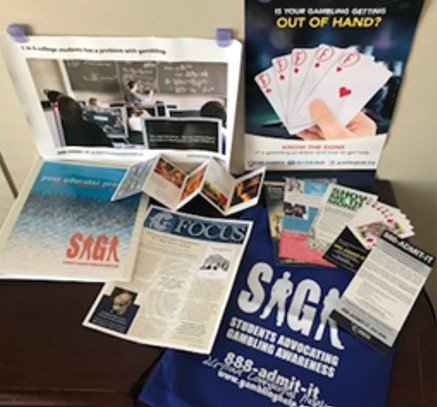
![[IMAGE] Students Against Gambling Addiction (SAGA) - College Toolkit](https://gamblinghelp.org/wp-content/uploads/2023/05/Students-Against-Gambling-Addiction-SAGA-Programs-and-Materials-1024x683.jpg)
Students Against Gambling Addiction (SAGA) Toolkit
The Students Against Gambling Addiction (SAGA) Toolkit was developed in cooperation with the University of Central Florida, and endorsed by the National Collegiate Athlete Association’s (NCAA) Department of Agent Gambling and Amateurism Activities (i.e. student athlete portion of SAGA program). In 2008, FCCG partnered with the REAL Project at UCF to develop Students Against Problem Gambling (SAGA). The REAL Project at UCF is a nationally recognized prevention and intervention program that provides services for students who are concerned about gambling problems as well as substance abuse. SAGA is designed to teach student leaders how to recognize signs of problem gambling and to connect their friends and classmates with resources available on campus and in the community.
SAGA aids institutions in devising campus-wide programs and provides training guides, lesson plans and associated materials for college counselors, peer advocates, resident advisors, financial aid personnel, coaches, students/student-athletes, administrators, and others. Similar to the middle and high school program, the FCCG works closely with colleges and universities statewide to develop and implement problem gambling awareness programs on campus. The FCCG SAGA program aids institutions in devising campus-wide programs, provides training for college counselors, educators, administrators and others, offers presentations for college students and athletes, and utilizes collateral materials and a webpage geared toward this population.
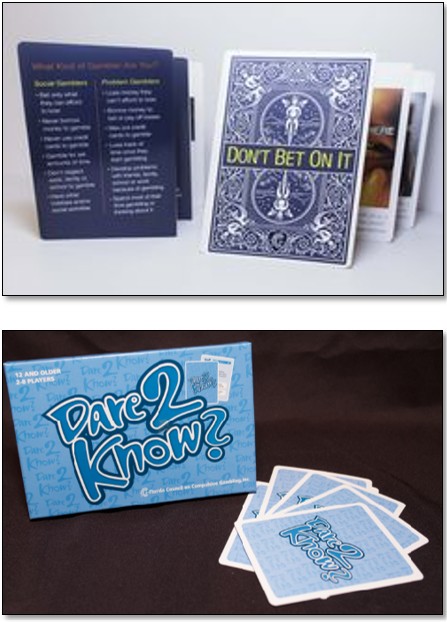
College Brochure & Card Game
The FCCG’s Don’t Bet on It brochure for college students and the Agency bookmark (see below) have also been identified as very eye-catching and informational items for college students. Both reflect the role of card play, and poker in particular, among this age group. Dare2Know is an interactive card game geared toward college-aged youth. The objective is to start the conversation around financial management and beliefs surrounding risky behaviors. In the course of the game, players discuss different forms of betting and how gambling addiction can impact anyone’s life.
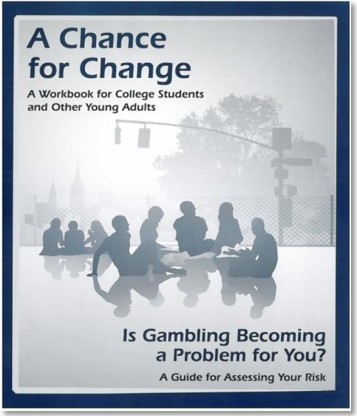
College A Chance for Change Workbook
The FCCG has also developed a College Workbook designed as a resource for counselors and as a tool to compliment the SAGA program. The workbook is comprised of two parts; student interactive activities and a counselor guide. Each student activity can be removed, copied, and then provided to the student to read and respond to, either with the counselor or on their own for future discussion when in a counseling session. The counselor guide will provide helpful information on the various student activities, as well as a reference to resources for further review and information. Essentially this workbook provides the tools necessary to aid young adults and college aged individuals in assessing the extent and impacts of their gambling and assists in leading a healthier lifestyle.
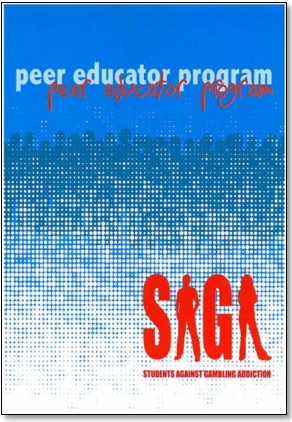
SAGA Peer Educator Program
The SAGA Peer Educator Program is an easy to use, structured, peer educators program, designed to train peer educators on issues surrounding problem and compulsive gambling amongst college students. The program includes a brief introductory letter to introduce the program and express the objectives desired by the FCCG, a presentation for Peer Educators to give to students, which includes information, questions to ask groups, interactive activities, a self-assessment, optional jeopardy questions which can be used as a game, some brief addendums with extra info for special populations (athletes, freshmen), and pre/post-tests with evaluations.
College SAGA Peer Educator Toolkit Video “Whose Gamble is it Anyway?” DVD for Professionals (Colleges/Universities)
This 12-minute comedy brings light to the dark realities of gambling addiction among the college student population through comedic skits based on a popular television show. Watch Bo, Rebecca, and Tony compete in Lou Flarey’s rendition of Drew Carey’s Whose Line is it Anyway?
College Resident Advisor Kits
As Universities often look to their Residence Life staff and particularly their Resident Assistants (RA’s) as a first line of defense in understanding information and resources available to aid a diverse student population in maintaining balance in all aspects of their college life as they transition to college, the FCCG developed RA toolkits that include college problem gambling posters, brochures and bookmarks, along with a For RA’s Only newsletter, outlining ideas for bulletin boards and programming, as well as referral resources for RA’s to use.
FOCUS Newsletters & the Dire Stakes Game for College Students
The FCCG also produces editions of its FOCUS Newsletter specifically for college students, offering timely insights, practical guidance, and relatable content that speaks directly to the campus experience. In addition, the FCCG provides a college version of its interactive computer game, Dire Stakes—an engaging, quiz‑style activity modeled after a Jeopardy‑style format using PowerPoint—to help students learn about gambling risks in a fun, interactive way that works well in classrooms, residence halls, and peer‑education settings.
Additional Problem Gambling Prevention & Awareness Materials
FCCG offers a wide range of awareness materials designed to be engaging, accessible, and effective. These include brochures on video gaming addiction, financial impacts, and warning signs of gambling problems, as well as bookmarks and posters tailored to youth and college audiences. These materials can be used in classrooms, youth programs, residence halls, and community settings to reinforce prevention messages and encourage early help‑seeking.

College Financial Impacts Brochure: “Show Me The Money”
A two-sided brochure with helpful tips and suggestions for college students with financial troubles related to gambling. Provides budgeting suggestions along with a financial exercise designed to help college student problem gamblers regain control of their finances as well as develop and sustain financial stability.
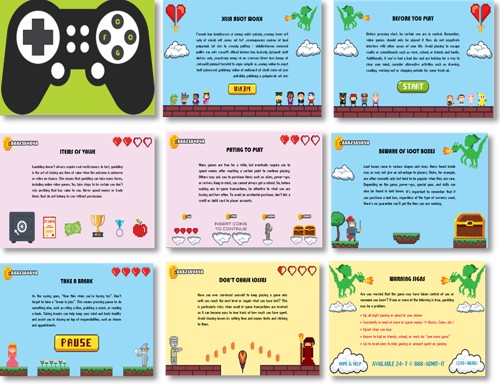
Youth/Teen Video Gaming Addiction Brochure “Play it Safe”
Pocket-sized brochure designed as a video game controller to appeal to youth gamers, provides important information about the risks and dangers of excessive gaming, including physical health problems, mental health impacts, and financial loss and consequences. Education for parents about virtual loot boxes, skins, power-ups, and other in-game financial transactions is provided, as well as important warning signs to look for in loved ones who game.
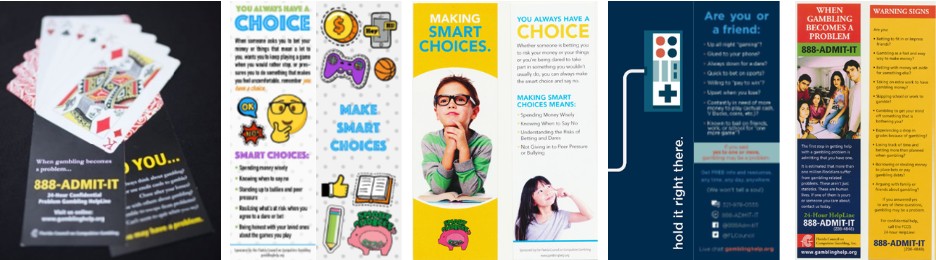
Prevention Awareness Bookmarks
The FCCG also offers a series of Prevention Awareness Bookmarks created specifically for college students, youth, and teens. These bookmarks are designed to be visually engaging, easy to understand, and ideal for quick distribution in classrooms, campus settings, and community programs. Each version delivers age‑appropriate messaging that highlights key gambling risks, promotes healthy decision‑making, and directs young people to trusted resources for help and information.
Prevention Posters for Professionals
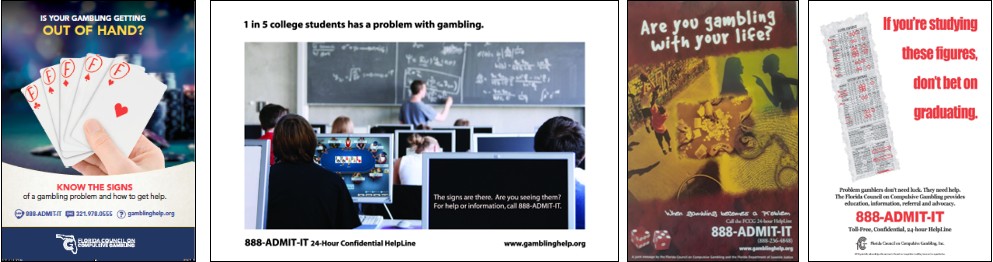
In addition to brochures and newsletters, the FCCG produces a series of posters geared toward youth, college students, and professionals that have been specially prepared to accompany the FCCG’s prevention programs.
FCCG’s Prevention Programs are Research‑Driven
FCCG’s prevention programs are built on decades of research examining gambling behaviors among Florida’s youth and college populations. Studies consistently show that gambling often begins early, is linked to other risk behaviors, and can lead to significant personal and academic consequences. These insights guide the development of FCCG’s curricula and ensure that each program addresses the real challenges facing young people today. By grounding its work in evidence, FCCG delivers prevention strategies that are both effective and relevant. FCCG youth- and college-specific research includes:
Gambling and Problem Gambling Prevalence Among College Students in Florida, A Report to the Florida Council on Compulsive Gambling, Inc., McGill University & University of South Florida, July 2008.
Gambling Among Florida Middle and High School Students: A Report to the Florida Council on Compulsive Gambling, Inc., Louis Lieberman, Ph.D. and Mary Cuadrado, Ph.D., June 2006.
Pilot Study of the Problem Gambling Prevention Program, Presented to the Florida Council on Compulsive Gambling, National Resource Center, University of South Florida, Tampa, 2003.
Gambling and Problem Gambling Prevalence Among Adolescents in Florida, A Report to the Florida Council on Compulsive Gambling, Inc., University of Florida, December 2002.
Gambling Education and Prevention Needs Assessment for Juveniles in Residential Detention Centers of the Florida Department of Juvenile Justice, Dr. Louis Lieberman and Dr. Mary Cuadrado, November 2002.

Interested in FCCG Programs?
All youth and college prevention materials are available by contacting the 24‑hour 888‑ADMIT‑IT HelpLine. Educators, youth service providers, families, and students can request toolkits, videos, and resources to support prevention efforts in schools, campuses, and community programs. Through these initiatives, FCCG remains committed to helping young people build healthier futures and avoid the harms associated with gambling.
Free Training Available for Curriculum Implementation
The Florida Council also provides free training to schools in advance of curriculum implementation to improve the awareness and prevention capabilities among school staff. Such training is provided at no cost to school districts and universities. While the programs are designed to enable educators to conduct lesson plans without outside assistance, prevention program training sessions are an option if desired, and vary in length depending on the institution or district’s program implementation plan. For more information, please contact the HelpLine.

